Wednesday, 7 March 2018

Proving Principia Axioms

Proving Principia Axioms

Principia Mathematica tried to construct the whole mathematics using calculus of proposition as its basic tool. The calculus itself is based on five simple axioms: tautology, addition, permutation, Association ad Summation. 


Based on this calculus, the whole Boolean algebra c
an be constructed. However, Boolean algebra can also be built on the base three axioms of Sheffer Hasil carian imej untuk ‪sheffer logic‬‏  which used only one logical NAND operation.

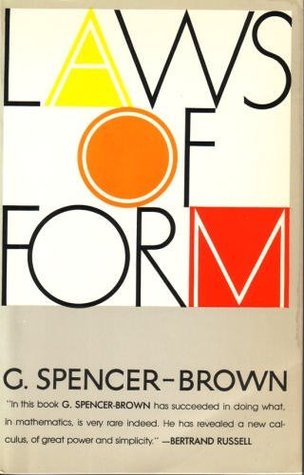
In the appendix of his book Laws of Form, George Spencer-Brown 
Hasil carian imej untuk ‪spencer brown logic‬‏ has proven that the three Sheffer axioms can be proven as consequences of his two simple axioms: position and transposition.

This means that the five axioms of the Principia's calculus of proposition can be derived from the two axioms of brownian algebra that can be simulated by the game of things as it is shown in my last blog.

In this blog we will represent the Principia axioms into a configuration of boxes and colored balls and challenge you to transform them to a single box representing TRUE. If you can do it, then you already proved they are  the consequences of Brownian algebra.


My proof is using the following first three consequences of Brownian algebra considered as rules of transformations in the Brownian game of things


Tautology can be proved by using generation twice ended by doing integration.
Addition, permutation and association can be proved in a similar manner.
Summation can be proved firstly by removing the red ball within the box, then removing the contents of the first box using generation ended by doing integration.


Friday, 26 January 2018

Gamifying Laws of Form

Gamifying Laws of Form
Armahedi Mahzar (c) 2018

When I finally understood primary algebra in the book entitled  Laws of Form Image result for Laws of form, I thought the calculus of indication is a notational and axiomatic simplification of the calculus of proposition as it is formulated by Russel and Whitehead in their book Principia Mathematica.

However, later, I realized that the primary algebra is essentially a pure algebra, not a logical algebra, so it is not really a notational simplification of Boolean algebra. It uses only purely algebraic inference rules: the substitution and replacement rule.

The Primary Algebra only becomes a Boolean algebra if we define AND and IF operations using LoF VOID operation which is interpreted as OR or AND operation. So, augmented Primary Algebra or augmented calculus of indication is isomorphic to the Principia calculus of proposition which used Modus Ponens as its only rule of inference. 

Consequently, the augmented calculus of indication which is not using logical inference rule is equivalent to a calculus of proposition using logical rule modus ponens.

For me, it is an amazing fact how the foundation of logic (calculus of proposition) and and the foundation of mathematics (calculus of indication) is actually similar.

Lately, I found out that the primary algebra can be proven, by Louis Kauffman, as  a system based on a single axiom, Huntington axiom, using only algebraic rules of inference.

I also found out the Boolean logic has been proven, by Charles Sanders Peirce, as a system based on a single axiom (TRUE symbolized as VOID in Existential Graph System) and five implicational logical rules who are not equal to modus ponens.


Fortunately, if we replace the single axiom to Consistency (p->p) the five rules can be reduced to just one rule ( generation (pq)q=(p)q or the third consequence C3 of the primary algebra. https://issuu.com/armahedimahzar/docs/the_simple_existential_graph_system  ) 

As the consequence, both foundations of logic or mathematics is just a game of symbols with formation rules (definitions and axioms) and transformation rules (equational or implicational rules).

However, when the symbols are represented by things the game of symbols becomes the Game of Things.So the foundation of logic and math is becoming just a game of things.

(The 3D gamification of LoF is discussed in my blog https://integralisme.wordpress.com/2013/06/21/528/  . The 2D gamification of LoF is discussed in my book 
  )

This finding astonished me. How can the abstract logic and math is equivalent to a concrete game? Why? What is the philosophical implication of this astonishing fact?